

New Parents: Room Temperature Guides Short vs Long Sleeve Bodysuits
Short-sleeve bodysuits win the everyday vote for most babies, most rooms, most months of the year. Buy long-sleeve pieces for two situations only: a home or nursery that consistently runs cool, or outings where a stroller and extra outdoor layer replace the indoor heat you’d otherwise dress for. The real rule isn’t sleeve length at all. It’s dressing for the temperature of the room your baby is actually in, not the weather outside the window.
TL;DR:
- Most homes maintain temperatures above 68°F, making short-sleeve bodysuits the most versatile daily base layer for babies.
- Long-sleeve bodysuits are best reserved for cooler rooms below 68°F, for streamlined outfits, or outdoor outings with fewer layers.
- Proper fit around the torso, neckline style, and snap gussets are more important than sleeve length for comfort and functionality.
- Lightweight, stretchable fabrics like cotton or bamboo in midweight jersey are ideal, and washing in cold preserves softness and prints.
- Dress your baby in one more layer than an adult would wear in the same environment, checking warmth at the chest or neck rather than hands or feet.
Table of Contents
- Short Sleeve vs Long Sleeve Bodysuits: Building Your Starter Rotation
- When Should You Use Short-Sleeve Bodysuits?
- When Do Long-Sleeve Bodysuits Make More Sense?
- How Do You Apply the +1 Layer Rule?
- What Fit Details Matter More Than Sleeve Length?
- Which Fabrics Make Sleeve Choice Easier?
- How Baby in Every Language Designs for Real-World Dressing
- Where the Featured Bodysuits Fit Your Sleeve Rotation
- Primary Sources for Temperature and Layering Guidance
- Sources
- FAQ
Short Sleeve vs Long Sleeve Bodysuits: Building Your Starter Rotation
You don’t need a packed drawer to get through the first few months. A small, well-chosen rotation beats a huge one you never fully use, and it makes gift-giving simple too.
Here’s a starter count that works for most families, adjusted for your laundry schedule and climate:
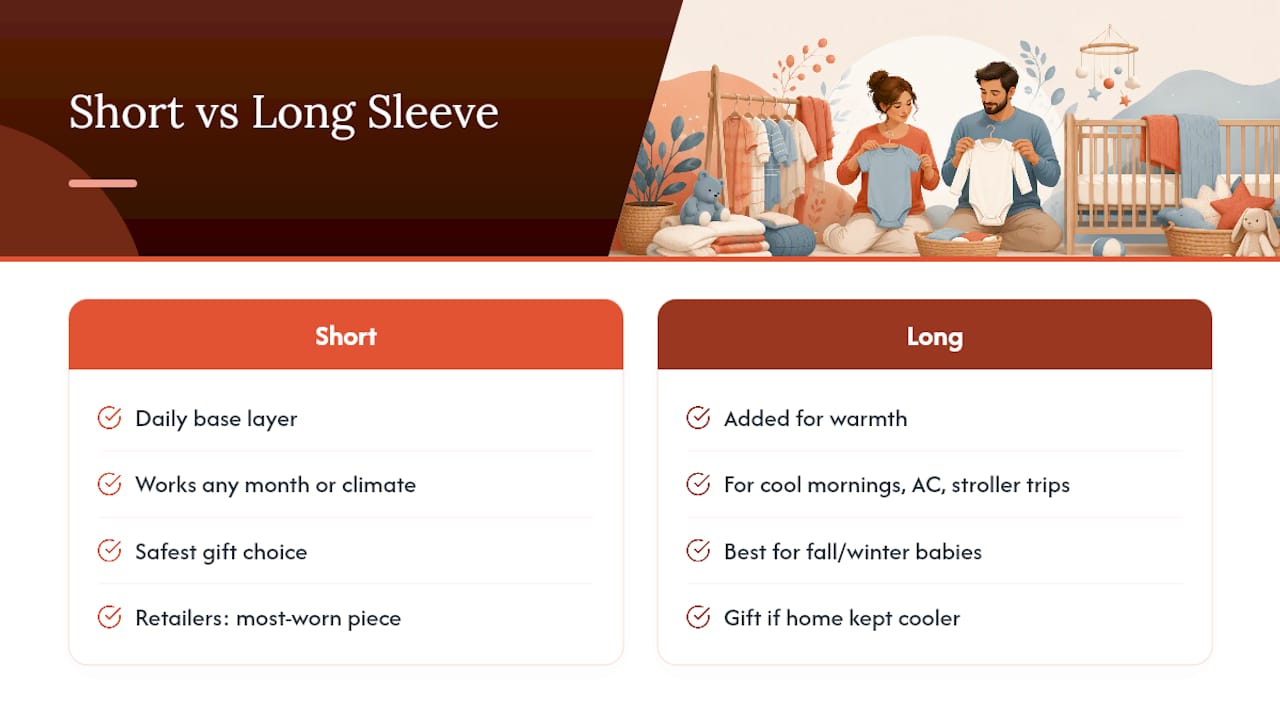
A small, well-chosen rotation of short-sleeve bodysuits as your daily base layer, with some long-sleeve bodysuits for cool mornings, air-conditioned rooms, or stroller trips, complemented by a selection of neutral colors so pieces mix across sizes and seasons without clashing.
If you’re shopping for someone else’s baby, short-sleeve is the safer gift. It works in nearly any nursery, any month, any climate. Long-sleeve makes a thoughtful gift too, specifically for babies born into fall or winter, or for families you know keep their home on the cooler side. Retailer guidance backs this up: short-sleeve tends to be the most-worn piece in the drawer, with long-sleeve added once routine or climate calls for it.
When Should You Use Short-Sleeve Bodysuits?
Short-sleeve earns its spot as the default for a simple reason: most homes run warmer than parents assume, and babies overheat more easily than they get cold. A living room at 72°F with central heating running is warm enough for a short-sleeve bodysuit and nothing else, or a short-sleeve bodysuit tucked into a sleep sack at bedtime.
Newborns benefit from short sleeves in ways that go beyond comfort:
- Easier access for umbilical cord care in the first couple of weeks, since you’re not working sleeves out of the way during changes.
- Less bulk underneath a swaddle, which matters when you’re already managing a blanket, a swaddle wrap, and a wiggly infant.
- Simpler dressing for car seats and strollers, where thick sleeves bunch up under straps and buckles.
Pro Tip: If you’re swaddling a newborn, skip the long sleeves entirely underneath. The extra fabric adds bulk exactly where you need the swaddle to stay snug and secure.
Parenting resources consistently point to short-sleeve as the most flexible base layer across the calendar, because it pairs with almost anything you add on top.
When Do Long-Sleeve Bodysuits Make More Sense?
Long-sleeve bodysuits solve a different problem: getting dressed faster with fewer pieces. On a cool morning, a long-sleeve bodysuit under one pair of pants is a complete outfit. No extra top layered underneath, no second garment to wrestle onto tiny arms while your baby squirms on the changing table.
Reach for long-sleeve when:
- Your home consistently sits below 68°F, especially in older houses or during shoulder-season months before the heat kicks on.
- You’re heading out for a stroller walk and want one solid layer instead of stacking a short-sleeve bodysuit under a jacket.
- You want a streamlined outfit for photos or outings without piling on separate layers.
One caution worth repeating: don’t stack two long-sleeve garments on top of each other. The added bulk around the elbows restricts arm movement, and a baby who can’t bend an arm freely tends to get fussy fast. If you need more warmth, add a single outer layer over one long-sleeve piece rather than doubling up sleeves.
How Do You Apply the +1 Layer Rule?
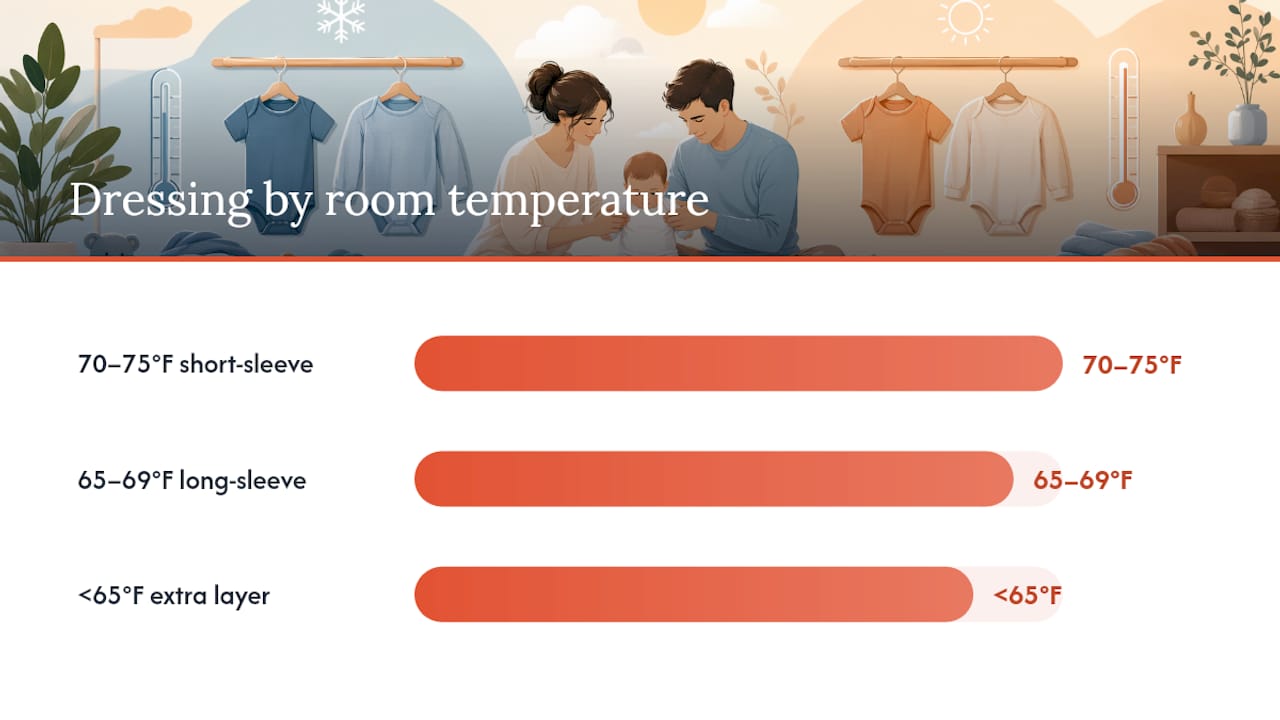
Pediatric guidance keeps circling back to one benchmark: dress your baby in one more layer than you’d wear yourself in the same room. If you’re comfortable in a T-shirt, your baby probably needs a short-sleeve bodysuit plus a light layer, not a heavy fleece.
A few concrete pairings make this easier to apply at home:
- Room at 70 to 75°F: short-sleeve bodysuit alone, or short-sleeve plus a sleep sack for naps and nighttime.
- Room at 65 to 69°F: long-sleeve bodysuit, optionally with a light sleeper or swaddle layered over it.
- Below 65°F: long-sleeve bodysuit plus one additional layer, such as a footed sleeper, rather than two long-sleeve pieces.
To check if you’ve got it right, feel your baby’s chest or the back of the neck rather than their hands or feet, which run cooler naturally. The American Academy of Pediatrics specifically recommends this check to avoid overheating, one of the more overlooked risks new parents don’t think to watch for. Damp hair at the neckline or sweat on the chest means it’s time to pull a layer off, not add one.
What Fit Details Matter More Than Sleeve Length?
Sleeve length gets all the attention, but a bodysuit that fits badly causes more daily frustration than the wrong sleeve ever will. Three things matter more:
- Torso length. A bodysuit that’s too short rides up and digs at the shoulders; one that’s too long bunches at the diaper. Measuring a well-fitting bodysuit flat gives you a real benchmark before buying a new size, rather than guessing from age labels alone.
- Neckline style. Envelope or crossover necklines stretch over the head without fighting a floppy newborn neck. Standard American-style necklines with snap shoulders work better once your baby has more head control, usually a few months in.
- Closure type. Snap gussets at the crotch make diaper changes fast because you’re not pulling the whole garment over your baby’s head. Pull-on styles without a gusset mean a full undress for every change.
Get these three right and sleeve length becomes a seasonal detail, not a daily struggle.
Which Fabrics Make Sleeve Choice Easier?
The right fabric does half the work sleeve length is supposed to do. Lightweight cotton and bamboo blends breathe well enough that a short-sleeve bodysuit in bamboo can feel comparable to a heavier long-sleeve piece in thick cotton.
A few things to look for when shopping:
- Seasonless weight. Midweight jersey cotton or bamboo works across more months than heavy waffle knits or thin, see-through cotton.
- Stretch. Fabric with some give lets a long-sleeve bodysuit move with a kicking baby instead of restricting the elbows and shoulders.
- Wash care. Cold water and a gentle cycle preserve both softness and non-toxic prints far longer than hot washes, which fade designs and stiffen fabric over repeated cycles.
How Baby in Every Language Designs for Real-World Dressing
This brand builds every bodysuit around one idea: humor that actually communicates a boundary, without sacrificing comfort. Designs like Handle With Love, No Kissing put a real message on a garment parents already have to put on their baby every single day.
Every piece uses soft, baby-safe materials printed with non-toxic inks, so the fabric performs the way this article recommends. It breathes, it stretches, and it holds up to frequent washing without cracking the print.
The phrases themselves are verified by native speakers in many languages, checked for cultural accuracy rather than a rough translation. A bodysuit meant for a multilingual household or a multicultural gift works well across languages without sounding stiff or off.
Where the Featured Bodysuits Fit Your Sleeve Rotation
Building the starter rotation above gets easier with a few specific pieces to anchor it. The Newborn Handle With Love, No Kissing Baby Bodysuit works as a short-sleeve base layer, the kind you’ll reach for most days regardless of season, and it’s available across newborn sizing where torso length matters most.

The No Smooching Allowed Baby Bodysuit comes in multiple sizes, making it easy to size up as your baby grows out of that first newborn stretch. And the Lips Keep Out Baby Bodysuit carries the same safety and messaging standards covered above, a clear boundary printed on soft, breathable cotton.
Measure a favorite bodysuit flat before ordering, using the torso-length method from earlier, and stick to cold washes to keep the print sharp wash after wash. Ready to build your rotation? Browse the full bodysuit collection and pick the sizes and languages that fit your family.
Primary Sources for Temperature and Layering Guidance
Safe-sleep and clothing guidance in this article draws on the American Academy of Pediatrics, the What to Expect Project, and fit guidance from YourSizer for torso measurement.
Sources
- American Academy of Pediatrics (AAP)
- SwaddleAN — Long Sleeve vs Short Sleeve Bodysuits guide
- What to Expect Project
- YourSizer — How to measure a bodysuit
- Joone — Short, long, or crossover: how to choose
FAQ
Are Long-Sleeve or Short-Sleeve Bodysuits Better?
Neither wins outright. Short-sleeve works better as an everyday base layer in most homes, while long-sleeve suits consistently cool rooms or outdoor outings, so most families end up needing both.
What’s Better, a Long Sleeve or a Short Sleeve, for a Newborn?
Short-sleeve is usually easier for newborns because it leaves more room around the umbilical cord area and adds less bulk under a swaddle.
When Should You Use Long-Sleeve Bodysuits?
Use long-sleeve when your home consistently runs below 68°F, or when you want one streamlined layer for a stroller walk instead of stacking a short-sleeve bodysuit under a jacket.
Are Short-Sleeve Bodysuits the Same as Vests?
Not exactly. “Vest” is a common term in some regions for the same sleeveless or short-sleeve base layer, but the design, snap gusset, and envelope neckline described above apply to both terms equally.
Should I Buy a Shirt or a Bodysuit for My Newborn?
A bodysuit beats a separate shirt for newborns because the snap gusset keeps the garment in place through diaper changes and movement, where a loose shirt rides up and leaves the belly exposed.