

New Parents: Norwegian Script, Carrier, and Bodysuit That Stop Strangers
Say, “Please don’t touch the baby, thank you,” in a warm but flat tone, no smile required. Pair it with babywearing so your hands stay full and your baby stays out of reach, and add a visible cue, like a bodysuit with a printed message, so you don’t have to say it twice. Newborn immune systems are still catching up, which gives you a clean, non-personal reason to hold the line.
TL;DR:
- Most infants’ immune systems are still developing, making limiting handling crucial during the first two to three months and especially in flu or RSV season.
- Pre-emptively announcing boundaries through messaging or visible cues significantly reduces repeated requests or touch attempts from visitors and strangers.
- Firm, calm rejection with a clear reason and body language effectively discourages persistent pushback from family members or overstepping individuals.
- Babywearing functions as a passive signal of unavailability, helping parents avoid conflicts and keep the baby close and soothed without verbal explanations.
- Consistent enforcement by all caregivers and family members, along with layered tools like scripts, clothing, and signs, ensures the boundary remains effective over time.
Table of Contents
- Why the “Norwegian Don’t Touch Baby” Idea Resonates With Parents
- What to Say to Strangers, Family, and People Who Won’t Take No
- Prevention Tactics That Work Before Anyone Has to Ask
- How to Handle Pushback Without Losing Your Cool
- Why This Approach Holds Up
- Getting Older Siblings and Caregivers on the Same Page
- Tools That Make the Boundary Easier to Hold
- The Real Problem With Most Boundary Advice
- Three Bodysuits That Say It So You Don’t Have To
- Sources
- FAQ
Why the “Norwegian Don’t Touch Baby” Idea Resonates With Parents
The urge to touch a baby is almost automatic. Soft skin, tiny hands, that new-baby smell. It triggers something wired deep in most people, and they act on it before thinking about consent. That instinct is exactly why the phrase “norwegian don’t touch baby” has caught on with parents searching for a workable script. It points to something real: Scandinavian parenting culture has a reputation for treating boundaries as normal, not rude.
Norwegian parenting guidance leans hard into this. Babyhub recommends new parents set explicit visit rules, ask for handwashing, and skip kisses in the newborn’s early weeks, treating a quiet postpartum period as a household default rather than an awkward request. That framing is worth borrowing, even if your extended family has never heard of it.
A few things translate well into any household, regardless of geography:
- Announcing the rule before the baby arrives, so nobody hears it as a personal rejection in the moment
- Treating “no handling for now” as standard practice, not a special exception you owe anyone an apology for
- Using visible signals, clothing, stroller tags, so the boundary doesn’t rely on a fresh conversation every time
Viral clips of Norwegian babies napping outdoors in freezing weather made the rounds a few years back, and they’re a good reminder: cultural practices don’t always transplant cleanly. Cold-weather napping works in a specific climate and infrastructure. Boundary setting works everywhere.
What to Say to Strangers, Family, and People Who Won’t Take No
Different people need different phrasing. A stranger at the grocery store gets something short. Grandma gets something warmer. Someone who keeps pushing gets something firmer.
- Strangers reaching for the baby: “I’d rather you not touch her hands, thanks. Her immune system’s still developing.” Said with a smile, this rarely causes offense. It gives a reason without inviting debate.
- Family and close friends: Lead with “we” instead of “I.” Framing it as a joint parental decision makes the boundary feel like policy, not a personal slight against that specific person. Try: “We’ve decided no one holds him for the first few weeks, it’s not about you, it’s just where we’ve landed.”
- When someone insists anyway: Drop the explanation and repeat the boundary. “I hear you, and the answer’s still no.” You don’t owe anyone a debate about your parenting choices, and a firm no is a complete sentence on its own.
Tone matters as much as wording. Keep your voice level and your body angled slightly away from the reaching hand, that small shift communicates more than most sentences do. Eye contact plus a calm “nope, not today” reads as confident rather than combative. Avoid over-explaining. Every extra sentence you add is an invitation for someone to negotiate.
Pro Tip: Practice your line out loud before you leave the house. Parents who rehearse a phrase even once tend to deliver it more naturally in the moment, instead of freezing or over-apologizing when someone reaches for the baby.
If a script needs backup, a politely-worded no-kiss request can give you extra phrasing options for people who still lean in for a kiss after you’ve already said no to holding.
Prevention Tactics That Work Before Anyone Has to Ask
The best boundary is the one you never have to state out loud. Babywearing does exactly that. When your baby is strapped to your chest in a carrier, most people read it instantly as “not available for holding” and don’t even ask. It’s a two-for-one: your baby stays soothed and close, and you skip the conversation entirely, since babywearing functions as a passive signal of unavailability as much as a comfort tool.
Safety still comes first. Choose a carrier that keeps your baby’s chin off their chest and their airway visibly clear, and check positioning every time you put them in, not just the first time.
Other tactics worth stacking:
- Stroller and car seat covers work well for quick errands, they physically block the reach even when you can’t manage a verbal exchange.
- Visible messaging does the talking for you. A bodysuit that reads “please don’t kiss me” or a stroller tag with a similar message reduces the number of times you repeat yourself, and gives you a graceful out when you’d rather not explain.
- Hygiene checks matter more in the first weeks. Ask visitors to wash their hands before any contact, and hold the line on kisses near the face.
Timing is not arbitrary here. Public-health guidance points to the newborn period, generally the first two to three months, as the window where limiting handling matters most, since a young infant’s immune system hasn’t built up defenses against common viruses like RSV and influenza. That risk climbs during fall and winter flu season, when these viruses circulate more heavily. If you’re navigating a household with older kids who bring germs home from school, the caution matters even more. A closer look at why pediatricians recommend limiting kisses during flu and RSV season breaks down the specific reasoning.
How to Handle Pushback Without Losing Your Cool
Someone will push back. Usually it’s a relative who feels entitled to hold the baby because of family status, or a stranger who thinks your rule doesn’t apply to them. Neither situation requires you to fold.
Keep a short list of de-escalation lines ready:
- “I know you love her, this isn’t personal, it’s just our rule right now.”
- “We’re not doing visitors holding the baby yet. We’ll let you know when that changes.”
- “No” on its own, repeated calmly, works better than most people expect.
If you’re out with a partner or a trusted friend, assign them as the buffer. A partner stepping in with “we’ve got this one” while gently redirecting the moment takes the pressure off you entirely, and it signals to the other person that the boundary is a shared decision, not a solo overreaction.
Know your exit points. If someone touches the baby after being asked twice, or a family gathering starts feeling like a standoff instead of a conversation, it’s fine to leave early or move to another room. One parent’s story that circulates often: a grandmother reached for a newborn mid-conversation, got a calm “not yet, remember?”, and the interaction moved on in under ten seconds. No confrontation, no lingering tension. That’s usually how it goes when the script is ready ahead of time.
Why This Approach Holds Up
The bodysuits are made from soft, baby-safe cotton and printed with non-toxic ink, ensuring safety against a newborn’s skin. The phrases in multiple languages are reviewed to ensure they convey the intended message naturally and appropriately.
Parents who’ve used a labeled bodysuit at family gatherings or pediatrician visits often report the same thing: fewer repeated conversations, because the shirt does the explaining. For deeper reading on the reasoning behind these products, why you shouldn’t let people kiss your newborn lays out the public-health case in plain language.
Getting Older Siblings and Caregivers on the Same Page
A boundary only holds if everyone in the house enforces it the same way. If your toddler or older child is used to hugging and kissing everything in sight, they need a simple, age-appropriate version of the rule, not a lecture. Something like “we give the baby gentle high-fives instead of kisses right now” works better than a long explanation about germs they won’t fully process.
Make older siblings part of the solution instead of another variable to manage. Ask them to help “guard” the baby’s space, hand you the carrier, remind visitors of the rule, point out the sign on the stroller. Kids tend to take ownership of a boundary faster when they’re given a job attached to it rather than just a restriction.
Grandparents, babysitters, and regular caregivers need the same clarity your partner has. Don’t assume they’ll intuit the rule from watching you enforce it once. Say it directly: “When you’re watching her, please don’t let visitors hold or kiss her for now.” If a caregiver disagrees with the rule, that’s a conversation to have privately, not in front of guests where it can undercut the boundary you’re trying to hold.
Consistency across every adult in the baby’s orbit is what actually makes a boundary stick. One household member quietly making exceptions erodes the whole system faster than any pushback from outside visitors.
Tools That Make the Boundary Easier to Hold
Scripts help in the moment, but a physical reminder does some of the work before you ever have to speak. A printed message on a bodysuit or a small stroller tag lets your baby’s outfit set the expectation before a hand even reaches out.
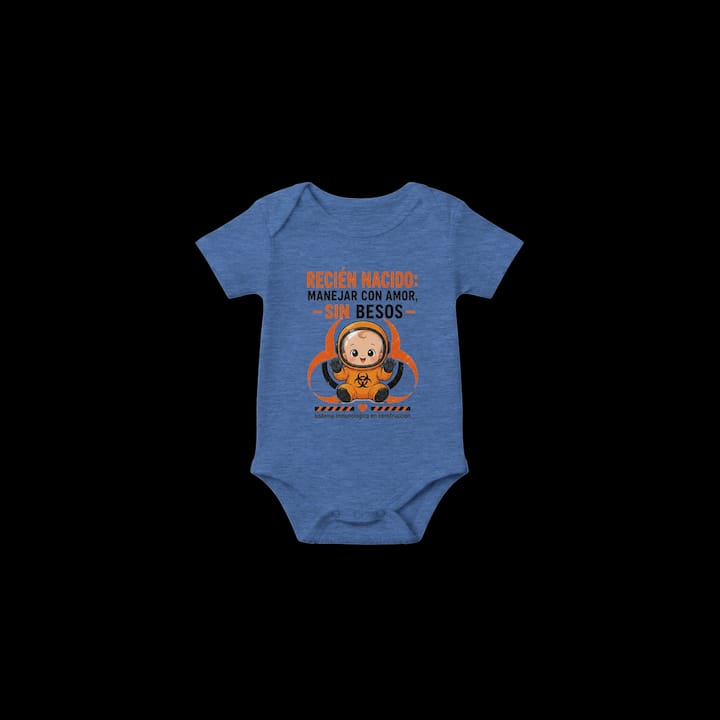
Boundary reminder cards work on the same principle for situations where a shirt isn’t practical, tucked into a diaper bag, handed to a well-meaning relative, or left on a stroller handle at a busy event. The wording stays short: a request, a light tone, no lecture attached. That brevity is the point. Nobody reads a paragraph taped to a stroller.
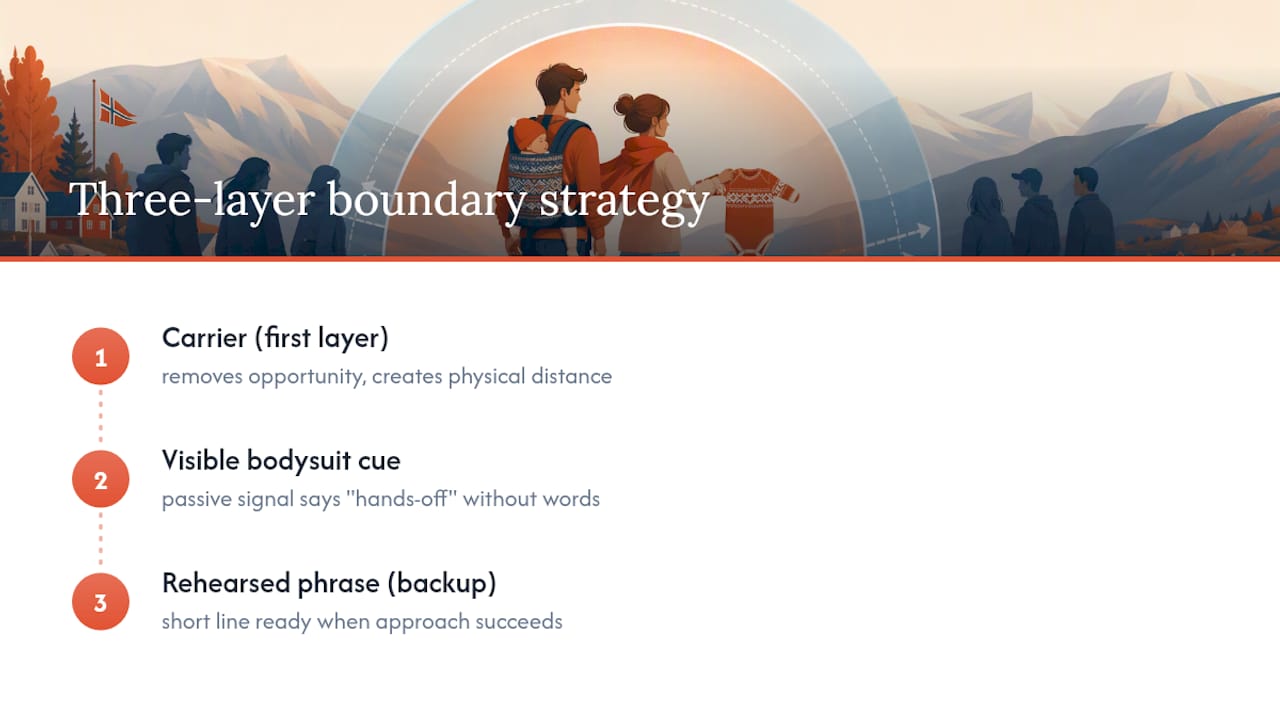
Layering tools tends to work better than relying on one. A carrier for physical distance, a visible message for social signaling, and a rehearsed phrase for the moments neither of those catches. Parents who set up more than one layer report needing to speak up far less often, because most people respond to the cue before it becomes a conversation at all.
If you’re weighing which option fits your family, a parenting safety resource on managing public outings with a new baby covers related precautions worth pairing with a visible-message strategy, especially for parents navigating crowded spaces or unfamiliar environments.
The Real Problem With Most Boundary Advice
Most advice on this topic treats the verbal script as the whole solution, memorize a line, deliver it with confidence, problem solved. That’s incomplete. A script only works in the split second you catch the reach coming. Half the time, someone’s hand is already on the baby before you’ve opened your mouth. The actual fix is layered: a carrier that removes the opportunity, a visible cue that does the talking passively, and a phrase in reserve for when both of those fail.
The Norwegian framing gets oversimplified too. People borrow the “boundaries are normal there” idea without the part that makes it work: those boundaries get stated before the baby arrives, not negotiated in the driveway during a visit. Pre-announcing a rule changes how it lands entirely.
What actually deserves priority is timing. The first two to three months carry the highest health stakes, which is also when social pressure to “let everyone hold the baby” peaks. That mismatch is where most new parents lose ground. Fix the timing problem first, and the scripts get a lot easier to deliver.
— Bassem
Three Bodysuits That Say It So You Don’t Have To
A visible message does the work a verbal script can’t always manage in the moment, it holds the boundary even when your hands are full or you’re mid-conversation with someone else. Each design features phrasing verified by native speakers to ensure the tone is appropriate in the chosen language.
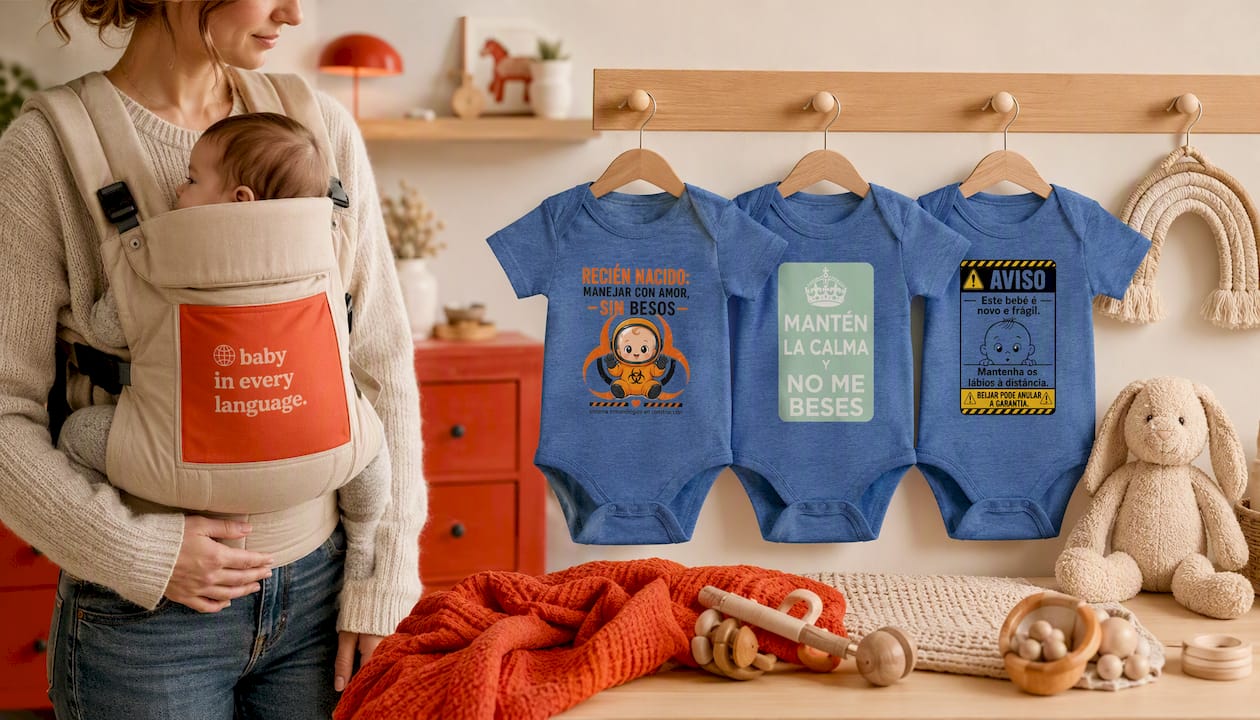
The Newborn Handle With Love No Kissing Baby Bodysuit pairs a gentle warning with a clear no-kissing request, ideal for the first weeks when hygiene concerns are highest. The Keep Calm And Dont Kiss Me Baby Bodysuit takes a lighter, more playful tone for parents who want the message to land with a laugh instead of a confrontation. The Warning New And Fragile Baby Bodysuit leans on protective language that discourages handling without needing to explain why.
These designs are printed on soft, baby-safe cotton with non-toxic ink. The phrases have been reviewed to ensure they convey the intended meaning suitably across multiple languages. Browse the full collection and pick the message that fits your family’s tone, playful, direct, or somewhere in between.
Sources
- Setting boundaries with family during the holidays — Good Company Therapy
- Babywearing benefits and safety — Hospital for Special Surgery health library
- Set boundaries against visits when baby is newborn — BabyHub (Norway)
FAQ
What Does “Norwegian Don’t Touch Baby” Actually Mean?
It refers to a cultural style of parenting, common in Norway and other Scandinavian countries, that treats explicit newborn boundaries as normal rather than confrontational. Parents there often set visit rules and hygiene expectations before guests ever arrive, based on Norwegian postpartum guidance.
How Do I Politely Tell Someone Not to Touch My Baby?
Keep it short and give a light reason without over-explaining: “I’d rather you not touch her hands right now, her immune system’s still developing.” A calm tone and a smile usually prevent it from feeling like a rejection.
Why Shouldn’t People Touch a Newborn’s Hands or Face?
Newborns haven’t built up defenses against common illnesses yet, and germs on hands and lips can spread RSV or flu, both of which pose more risk to infants than to older kids or adults. That risk is highest in the first two to three months, especially during flu season.
Does Babywearing Really Stop People From Asking to Hold the Baby?
Yes, in most cases. Babywearing signals that a baby is currently unavailable for holding, which tends to prevent the request before it happens rather than forcing you to decline it out loud.
Can a Bodysuit or Sign Really Replace Saying “Don’t Touch My Baby”?
It often reduces how many times you need to say it, though it works best paired with a verbal script for people who miss the cue. The bodysuits are designed for that purpose, with phrasing verified to ensure the message is clear across multiple languages.