

3 Ready-to-Order Baby Bodysuits With a Native-Verified Malay Phrase
The phrase to print is “Tolong jangan sentuh bayi saya.” It translates literally to “Please do not touch my baby,” and it’s the version native Malay speakers confirm sounds natural, polite, and clear on baby apparel. Skip blunter alternatives. This one carries the right tone for strangers, relatives, and everyone in between.
TL;DR:
- Using “Tolong jangan sentuh bayi saya” ensures the request is polite, personal, and culturally appropriate, especially compared to blunt alternatives.
- Proper pronunciation requires emphasizing “toh-long,” with careful articulation of “jangan” and “sentuh” to avoid sounding choppy or rushed.
- Including “tolong” rather than omitting it significantly affects how the message is received, making it less confrontational and more culturally sensitive.
- Shortening the phrase to just “Tolong jangan sentuh” fits well on small bodysuits and maintains clarity, especially with a simple, bold font.
- Pairing the phrase with a friendly tone and a relaxed body language helps reinforce politeness and reduces the risk of misunderstandings in public.
Table of Contents
- What Does “Tolong Jangan Sentuh Bayi Saya” Actually Mean?
- How Do You Pronounce This Malay Phrase Correctly?
- Why Does Polite Phrasing Matter So Much in Malay Culture?
- How Should You Print the Phrase on a Bodysuit?
- How Do You Pair the Phrase With Tone in Public?
- Why This Phrase, and Why It’s Worth Getting Right
- Ready-to-Order Bodysuits With the Malay Phrase
- Sources
- FAQ
What Does “Tolong Jangan Sentuh Bayi Saya” Actually Mean?
Malay builds meaning in a straight line, which makes this phrase easy to pick apart even if you’ve never studied the language. Each word carries its own job, and together they form a request that reads as courteous rather than sharp.
Here’s the breakdown:
- Tolong — “please.” This is the softening word that turns a command into a request. Leaving it off changes the entire feel of the sentence.
- Jangan — “do not.” A direct negation, but it never sounds harsh once “tolong” comes first.
- Sentuh — “touch.” Simple and specific, with no ambiguity about what’s being asked.
- Bayi — “baby.” The subject of the request.
- Saya — “my.” Marks ownership and makes the sentence personal rather than generic.
You’ll sometimes see the variant “Tolong jangan sentuh bayinya,” which swaps “saya” for “nya,” a suffix that means roughly “the” or “his/her” in this context. It’s grammatically fine, but it reads slightly more detached, closer to “please don’t touch the baby” than “please don’t touch my baby.” For a bodysuit worn by one specific infant, the direct “bayi saya” version hits harder and reads more personal at a glance, which matters when someone’s eyes only linger on the text for a second or two.
How Do You Pronounce This Malay Phrase Correctly?
Malay pronunciation is fairly forgiving compared to tonal languages, but a few sounds trip up English speakers. Here’s a phonetic breakdown you can practice out loud before you commit to a print order:
- Tolong — “TOH-long.” Stress the first syllable; the “o” sounds like the one in “toe.”
- Jangan — “JAH-ngahn.” The “ng” blends together like the end of “sing,” not a hard “g.”
- Sentuh — “SEN-tooh.” Rhymes loosely with “when-too.”
- Bayi — “BAH-yee.” Two clean syllables, no diphthong.
- Saya — “SAH-yah.” Common in everyday Malay, so it should feel familiar fast.
The most frequent mistake is hardening the “ng” in “jangan” into a distinct “n” plus “g” sound, which makes the word choppy. Another is rushing “sentuh” into one syllable. Slow down and separate it into two.
If you’re buying this for a gift and want to say it out loud at the shower or hospital, consider practicing it and, if possible, consulting a native speaker or Malay-speaking acquaintance for accuracy. A quick voice memo comparison beats guessing.
Why Does Polite Phrasing Matter So Much in Malay Culture?
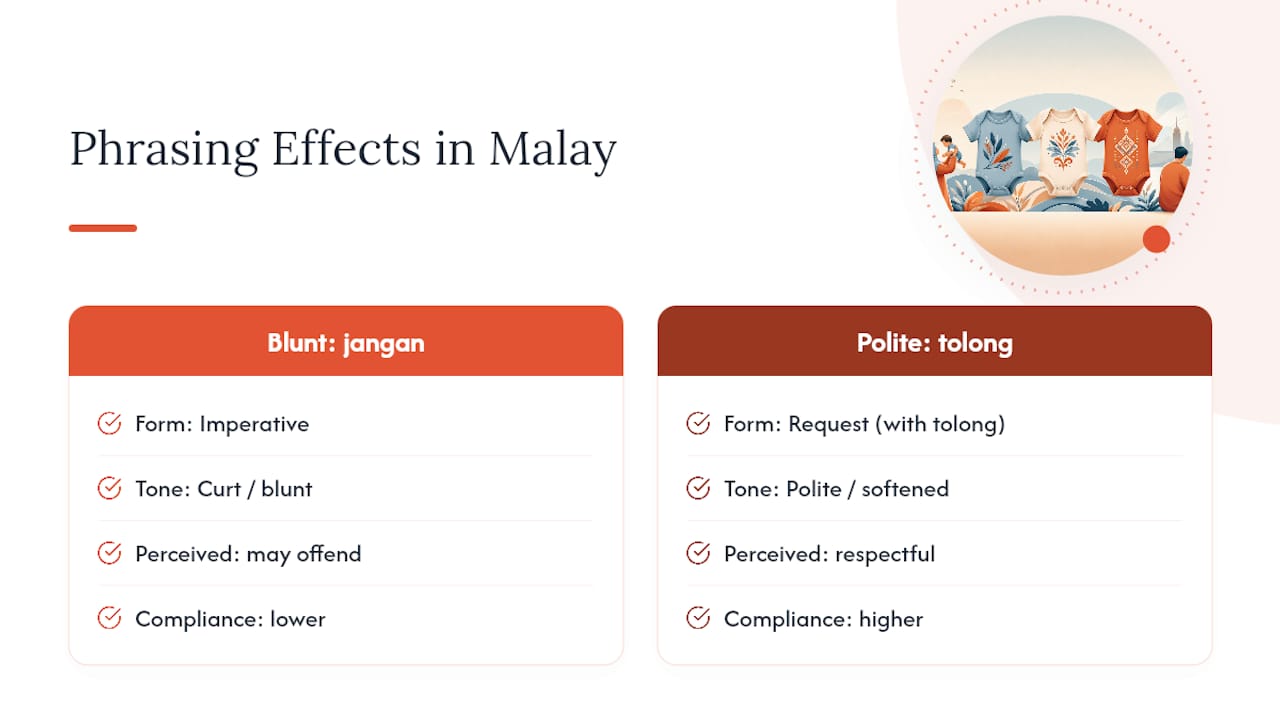
Malaysian communication leans heavily on preserving harmony and avoiding direct confrontation, especially with strangers or elders. A flat imperative like “jangan sentuh” (“don’t touch”) without “tolong” can land as curt, even rude, in a culture where softening language is the norm rather than the exception. Adding “tolong” isn’t decorative. It’s the difference between an order and a request, and in Malay social contexts, that distinction shapes how the message gets received and how willing someone is to comply.
This matters more than it might seem, because physical affection toward infants runs deep in many Asian caregiving traditions. Cross-cultural research on childcare practices in three Asian countries documents frequent physical contact with babies as a cultural norm, not an outlier. Relatives, neighbors, even strangers at the grocery store often reach for a baby’s cheek or hand without a second thought.
That’s exactly why a polite, native-phrased message works better than a stern one. A chapter on parenting and cultural practices describes how printed messages function as “silent communicators,” letting parents set a boundary without repeating the same awkward explanation to every well-meaning aunt or grocery store stranger. Malay etiquette guides on the region also point to politeness as a consistent thread running through everyday interactions, reinforcing why “tolong” belongs in the sentence, not just as an option, but as the expected form.
How Should You Print the Phrase on a Bodysuit?
Infant bodysuits give you a narrow, curved surface to work with, so wording and layout choices matter more than people expect. A phrase that reads perfectly on paper can turn into a cramped mess once it’s stretched across a size 0 to 3 months chest panel.
A few practical guidelines:
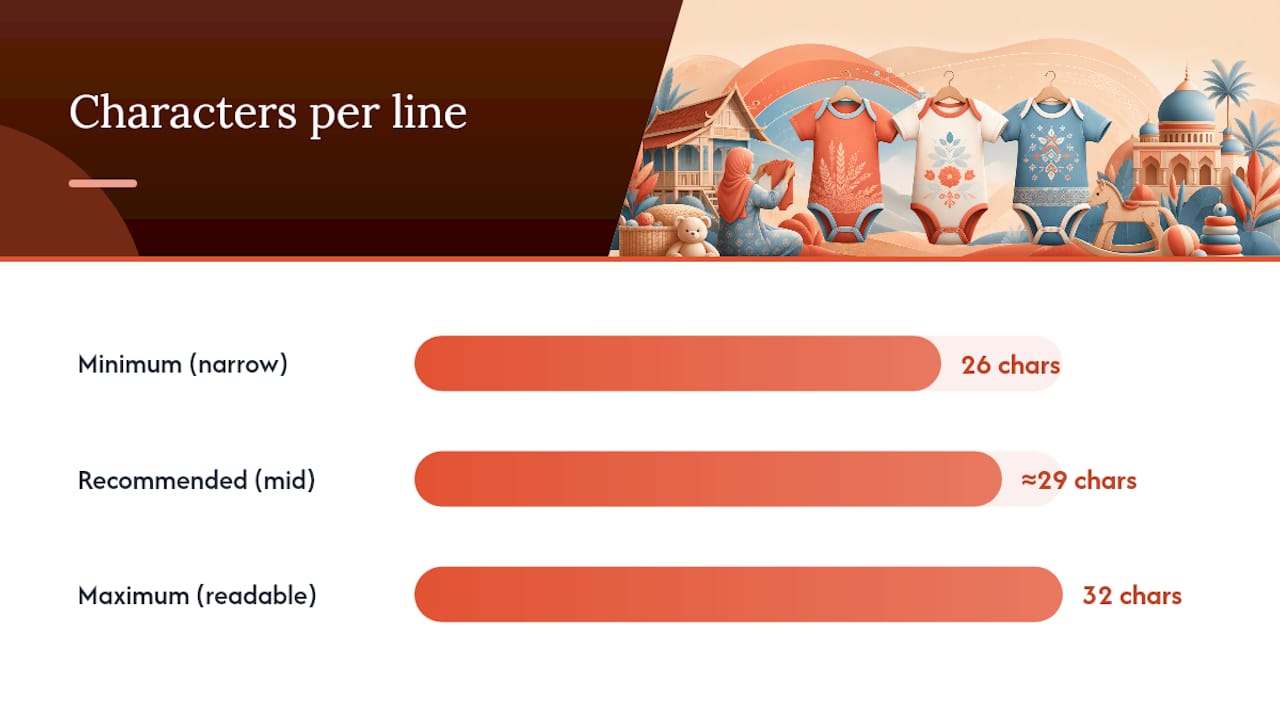
- Keep each line to roughly 26 to 32 characters for standard infant sizes. Longer lines shrink the font until it’s hard to read from a normal distance.
- Choose a bold, rounded sans-serif font with strong contrast against the fabric color. Avoid cursive or decorative scripts. They look charming on a mockup and become unreadable the moment the baby moves.
- For single-line designs, shorten to “Tolong jangan sentuh” (“Please don’t touch”), which drops “bayi saya” since the context is obvious from the garment itself.
- For a fuller message, use “Tolong, jangan sentuh bayi saya.” on two stacked lines: “Tolong, jangan sentuh” on top, “bayi saya” below.
Pro Tip: If you’re designing for a gift, stick with the two-line stacked version. It reads slower and more deliberately, which tends to draw a smile rather than a double take, and it still fits comfortably within standard newborn through 6-month bodysuit dimensions.
Line breaks should fall at natural phrase boundaries, not mid-word. Splitting “sentuh” across two lines defeats the entire purpose of a quick, legible message.
How Do You Pair the Phrase With Tone in Public?
The bodysuit does a lot of the work, but body language finishes the job. A friendly posture, a light smile, and brief eye contact keep the interaction warm even while the shirt is doing the talking. Nobody wants to feel scolded by a onesie, and pairing the printed message with a relaxed demeanor keeps things that way.
If someone reaches in any way, a short verbal line backs up the print without escalating the moment:
- Try the direct route: “Please don’t touch, thank you.” Short, polite, effective.
- In Malay: “Tolong jangan sentuh, terima kasih.” Same structure, same tone, and it lands especially well with Malay-speaking relatives or friends who appreciate hearing it in their own language.
- Save the verbal script for situations where the bodysuit alone isn’t registering, like a crowded event where people might not glance down before reaching out.
Parents who’ve tested this combination report fewer awkward standoffs than when they rely on a blunt verbal refusal alone, according to guidance on politely declining kisses for a newborn. The shirt opens the conversation. The smile closes it without drama.
Why This Phrase, and Why It’s Worth Getting Right
Getting a translation “close enough” is a common trap, and it’s one worth avoiding here. Malay has several ways to say “don’t touch,” and plenty of them are grammatically correct but socially off. A phrase lifted from a generic translation tool might technically mean the same thing while landing with an entirely different tone, sometimes closer to a command than a request.
What people tend to underestimate is how much a single word like “tolong” changes the emotional register of a sentence. It’s not filler. It’s the mechanism that keeps a boundary from sounding like a scolding, and that distinction is exactly what separates a phrase that gets a laugh from one that gets an awkward silence.
Bassem, writing on parenting and infant care topics for Babyineverylanguage, has spent time looking closely at how native speakers react to different phrasings across the brand’s 20-plus supported languages. The consistent finding: phrases that skip softening words tend to draw more pushback from native reviewers than ones that include them, even when the literal meaning is identical. That’s the whole reason Babyineverylanguage runs every phrase past native speakers before it goes on a bodysuit, uses 100% cotton, and prints with non-toxic inks, because a boundary-setting message only works if the wording itself doesn’t create a new problem.
— Bassem
Ready-to-Order Bodysuits With the Malay Phrase
If you’d rather skip the font decisions and just order something that already looks right, Babyineverylanguage carries three designs built exactly for this purpose.
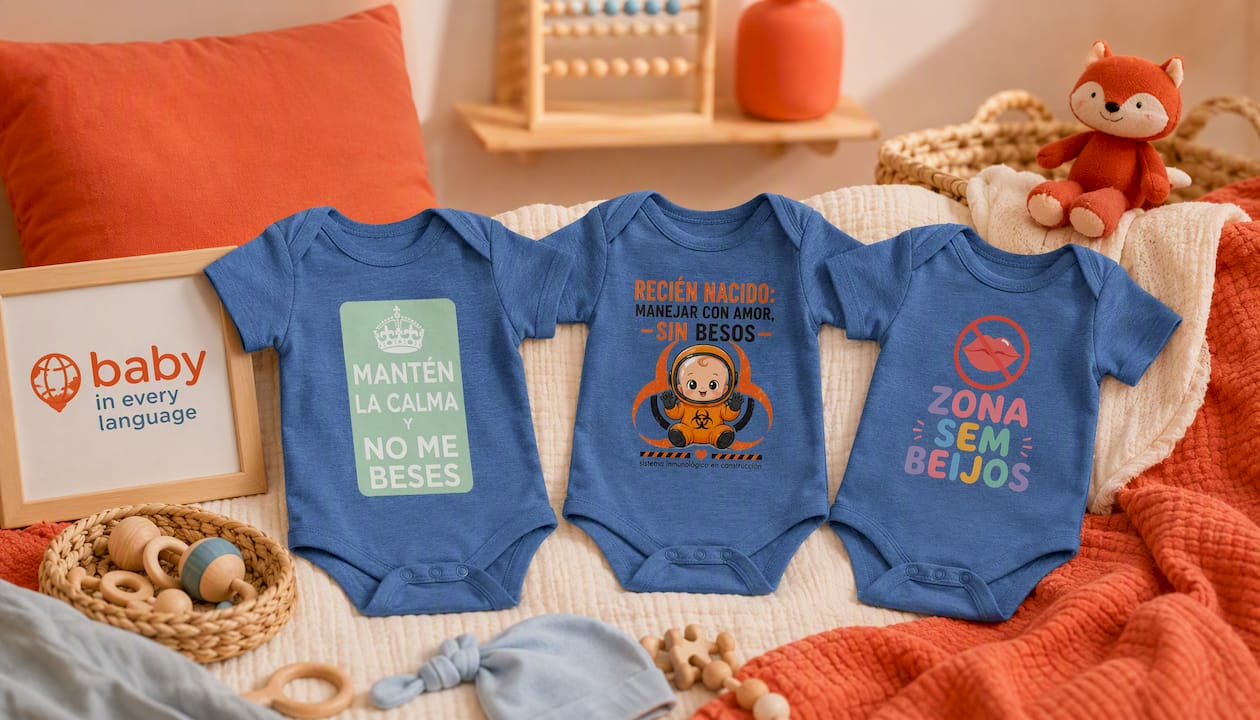
The Keep Calm And Dont Kiss Me Baby Bodysuit uses a playful, retro-style layout that softens the message with humor, a solid pick for gift-giving without feeling too pointed. The Newborn Handle With Love No Kissing Baby Bodysuit leans into a gentler, “handle with care” framing that reads well for baby shower gifts. The No Kiss Zone Baby Bodysuit takes the most direct route with bold, sign-style lettering that gets noticed fast in a crowded room.
Every design ships made-to-order, typically covering newborn through 18-month sizing, and you can request the Malay phrasing at checkout instead of the default English wording. If you want a different language entirely, Babyineverylanguage’s multilingual baby phrase guide covers over 30 options, all native-verified the same way. Browse the full lineup of humorous baby bodysuits to compare designs side by side before you order.
Sources
- IntechOpen chapter on parenting and cultural practices
- Childcare practices in three Asian countries (scholarly paper)
FAQ
What is the best Malay phrase for a “don’t touch my baby” onesie?
“Tolong jangan sentuh bayi saya” is the recommended phrase, translating to “Please do not touch my baby.” It’s native-verified for tone and reads as polite rather than confrontational, which fits Malay social norms better than shorter, blunter alternatives.
Is “jangan sentuh saya” the same as “don’t touch my baby”?
No. “Jangan sentuh saya” means “don’t touch me,” referring to the speaker, not the baby, and it drops the polite “tolong” entirely. It reads far more abrupt and isn’t recommended for baby apparel.
How do you say “don’t kiss me” in Malay for a baby bodysuit?
A polite version would be “Tolong jangan cium saya,” using “cium” for “kiss” in the same structure as the touch phrase. Pairing it with a friendly tone, as covered in Babyineverylanguage’s guide on declining newborn kisses, keeps the interaction light.
Does Babyineverylanguage offer this phrase in Malay on real products?
Babyineverylanguage’s product line includes designs like the Keep Calm And Dont Kiss Me Baby Bodysuit and No Kiss Zone Baby Bodysuit, where you can request Malay phrasing at checkout. Pricing details are listed directly on each product page.
Why does the phrase use “tolong” instead of a direct command?
“Tolong” softens the request from a command into a polite ask, which matches Malaysian communication norms that favor harmony over bluntness. Dropping it risks the message being read as rude, even when the underlying request is identical.