

Keep Baby Kiss Free: Wording, Scripts and Bodysuits for New Parents
“To keep our little one healthy, we kindly ask that guests skip kisses and face-touching, especially in these early weeks.” That single line, placed on your invitation or details card, is the most direct way to set the expectation before anyone walks in the door. It works because it names the request plainly, gives a warm reason, and appears where guests are already reading.
TL;DR:
- Placing a clear request on the invitation reduces awkward correction and helps guests understand the importance of avoiding kisses during the first two months.
- Different wording options suit various relationship levels, from playful bodysuits to more formal explanations, ensuring the message is both effective and considerate.
- A short, polite explanation on the invite, website, or RSVP helps set expectations early and prevents confusion at the event.
- Consistent, confident wording paired with a visible bodysuit reduces the need for repeat corrections during gatherings.
- Communicating the high-risk period early and in multiple formats helps protect newborns while maintaining positive guest interactions.
Table of Contents
- Why set a no kissing rule in the first place
- Ready-to-use wording for every kind of invite
- Where the wording belongs in your invite suite
- What to say when someone pushes back
- A bodysuit that says it for you
- Clarity is kinder than a hint
- Try a bodysuit that backs up your invite wording
- Where to read more on this topic
- Sources
- FAQ
Why set a no kissing rule in the first place
Newborns have immature immune systems, which makes them more vulnerable to the viruses that adults and older kids shrug off. According to guidance from Mayo Clinic Press, pediatricians recommend extra caution in the first two months of life, when babies are least equipped to fight off common respiratory illness. The same guidance notes that many parents ask visitors to skip mouth and face contact altogether, though some allow a back-of-head kiss from very close family.

Pediatric sources also point to a broader strategy called cocooning. As explained by Healthychildren, cocooning means making sure the people closest to a newborn are current on their vaccines and avoiding face-to-face contact when they might be contagious. Framed as something family and friends can help with, rather than a punishment, cocooning tends to land better than a bare rule.
Stating the expectation on the invite, before anyone arrives, avoids the awkward moment of correcting someone mid-hug.
- Newborn immune systems are still developing, making the first weeks the highest-risk window.
- Cocooning works best when everyone close to the baby is on the same page in advance.
- A written line on the invite prevents the need for a live, in-person correction.
A note on timing: pediatric guidance points to the first two months as the period of highest vulnerability, which is exactly when a gathering like a baby shower, homecoming, or meet-the-baby visit is most likely to happen.
Ready-to-use wording for every kind of invite
Different guest lists call for different tones. A coworker gathering and a grandparent’s living room visit don’t need the same phrasing, so pick the version that fits the relationship and the formality of your invite.
Short, one-line options:
- “In loving care of our newest arrival, we ask that guests refrain from kissing or touching baby’s face.”
- “For baby’s health, please save your love for smiles, waves, and hugs, no kisses, please.”
- “Baby is brand new to germs, so we’re asking for kiss-free cuddles only.”
Guest-specific variations:
- Close family: “We know you’re dying to smooch that face, but doctor’s orders say hands and lips off for now, hand hugs are welcome.”
- Friends and casual guests: “Come meet the baby! Just a heads-up, we’re keeping kisses off the menu for the first few months.”
- Coworkers or acquaintances: “We’re so glad you can join us. As a small request, please avoid kissing or handling baby’s face during the visit.”
- Virtual or hybrid guests: “Joining by video? No health precautions needed there, but we’d love to see your face on screen when baby wakes up.”
For longer formats, a wedding-style or website-based explanation gives more room to be warm and specific. One version recommended by etiquette copywriters at Darby House reads: “To keep our little one healthy, we kindly request no kissing or face-touching during our gathering.” That phrasing works equally well on a baby shower invite, a homecoming announcement, or a printed details card.
RSVP and details-card pairings:
- RSVP line: “By replying yes, you’re helping us keep baby’s first weeks kiss-free and cozy. Thank you for understanding.”
- Details card: “Baby’s first few months are all about building immunity. We ask all guests to skip kisses and face contact, hand-holding and cuddles are still very welcome.”
- Website footnote: “Curious why we’re asking for no kisses? Newborns benefit from a strategy called cocooning, keeping close contacts healthy and face contact minimal during the earliest weeks.”
Where the wording belongs in your invite suite
Guests need to see the request before they decide how to behave, not after they’ve already leaned in for a kiss. That means placement matters as much as wording.
- Put the one-line request near the time, date, and location, the spot guests read most carefully.
- Use a separate details card for the longer version if your main invite is formal or has limited space.
- Add an expanded explanation to your event website or RSVP confirmation page, where guests who want context can find it.
- For higher-boundary situations, such as a newborn’s first holiday gathering, send a short save-the-date or pre-invite note weeks ahead so people can adjust expectations early.
Event copywriters at Rizz Invites note that placing a guest-policy line near the RSVP or the time and place section, rather than burying it in fine print, prevents confusion and awkward enforcement once guests arrive. Advance notice, especially through a save-the-date, also gives guests time to arrange childcare or simply come to terms with the policy before the event, according to Darby House.
What to say when someone pushes back
Even a clearly worded invite won’t stop every well-meaning aunt or excited coworker from leaning in for a kiss. Having a short response ready keeps the moment light instead of tense.
- In person: smile, turn your shoulder slightly, and say, “We’re keeping kisses off the table for now, but she’d love a wave!”
- By text or email to family who question the rule: “We know it’s hard to resist that face! Our pediatrician suggested holding off on kisses for the first couple months, we really appreciate you helping us out.”
- For a consistent exception, some parents allow a back-of-head kiss from grandparents or very close family, a middle ground noted in guidance from Mayo Clinic Press. Apply it the same way for everyone in that category to avoid hurt feelings.
- If someone insists, a calm repeat works better than a new explanation: “I hear you, and we’re still keeping to no kisses for now.”
Pro Tip: Keep one script saved in your phone’s notes app so you’re never caught improvising in front of a room full of relatives.
A bodysuit that says it for you

A printed message does some of the enforcing without you having to repeat yourself all afternoon. When a baby arrives at a shower or gathering already wearing a bodysuit that states the boundary, guests read it before they reach for a hug, which cuts down on the awkward mid-hug correction.
Playful, one-line invites pair naturally with a humorous piece like the No Smooching Allowed Baby Bodysuit, while a more formal invite or details card pairs better with something understated, like the Warning New And Fragile Baby Bodysuit. Each design is printed on soft cotton with non-toxic inks, with phrases available in more than 20 languages, useful for multicultural families who want the message to read naturally in more than one tongue.
A visible, worn message reduces the number of times you have to say the same thing out loud.
For more scripts on declining kisses in person, see our guide on politely asking people not to kiss your newborn.
- Lips Keep Out Baby Bodysuit, a clear and playful option for casual visits.
- Kiss Free Zone Baby Bodysuit, straightforward wording for family gatherings.
- No Kiss Zone Baby Bodysuit, a simple daily-wear option for the first weeks home.
Clarity is kinder than a hint
New parents often soften the ask so much that guests miss it entirely, then feel blindsided when they’re corrected in front of others. A direct, warm sentence on the invite spares everyone that discomfort. It also spares you the mental math of deciding, guest by guest, whether this is the moment to say something.
The easiest habit is sending the notice before the event, not during it, and keeping one polite script ready on your phone so you’re never scrambling. Boundaries stated early read as thoughtful hosting, not as an accusation.
— Bassem
Try a bodysuit that backs up your invite wording
Saying “no kisses” once on the invitation is a good start. A bodysuit that repeats the message in person means you’re not the only line of defense once the party gets going.
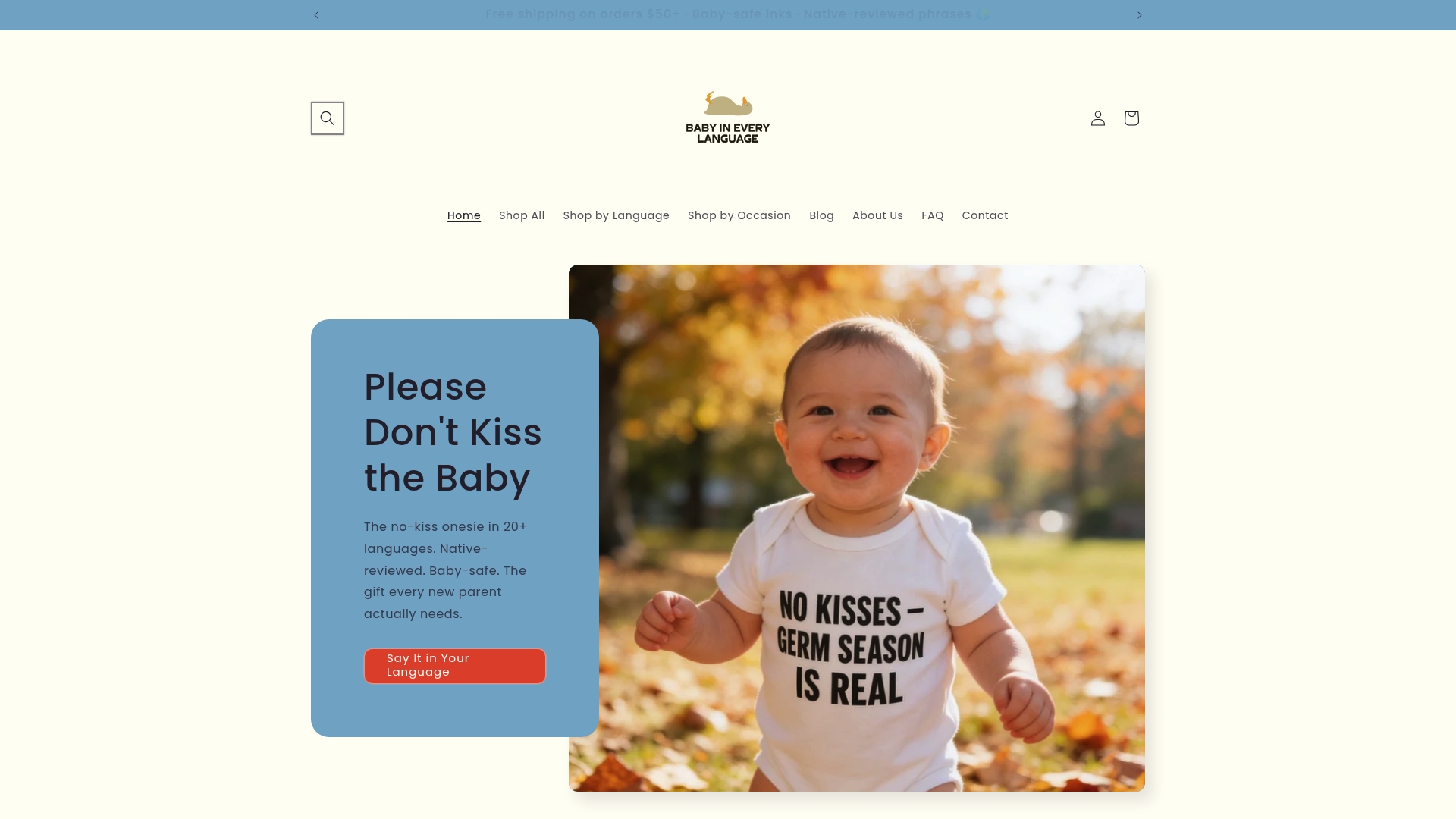
A few options to match different invite tones:
- Playful hosts pairing a humorous invite line often reach for the No Smooching Allowed Baby Bodysuit or the Keep Calm And Dont Kiss Me Baby Bodysuit.
- For a gentler, more formal tone, the Newborn Handle With Love No Kissing Baby Bodysuit states the request without sounding sharp.
- Families who want the phrase in a specific language beyond English can browse the full language selection or start with the Mandarin collection.
Browse the full Humorous Baby Bodysuits line, or start with the newborn essentials collection if you’re shopping ahead of a shower or homecoming.
Where to read more on this topic
- Mayo Clinic Press covers pediatric guidance on kisses, face contact, and the highest-risk newborn window.
- Healthychildren explains cocooning and why keeping close contacts current on vaccines matters.
- Darby House and Rizz Invites offer practical phrasing and placement advice for event invitations.
- Honey & Sage has retail-friendly gift and invite tone examples worth a look for baby showers.
This article is general information, not a substitute for advice from a qualified doctor. Consult a qualified healthcare professional about your own circumstances before acting on anything here.
Sources
- Should I let people kiss my baby? - Mayo Clinic Press
- Healthychildren
- How to politely let guests know your wedding is adult-only - Darby House
- How to word adults-only invitations without sounding harsh - Rizz Invites
FAQ
What is a catchy invitation phrase for a baby event?
A catchy line pairs warmth with a clear ask, such as “Come meet the baby! Just a heads-up, we’re keeping kisses off the menu for now.” It states the boundary while still sounding celebratory rather than strict.
How do you say “girls only” on an invitation?
A simple, friendly line works best, such as “This one’s just for the ladies, come as you are!” Keep it short and place it near the event details so guests know before they RSVP.
What is a polite way to say no extra guests on a birthday invitation?
Naming the invited guests directly on the envelope or invite, such as addressing it to specific people by name, sets the expectation without a blunt rule. A line like “We’ve reserved a spot just for you, this celebration is for named guests only” reinforces it politely.
What wording should I use for an adult-only party?
Etiquette guidance from Rizz Invites suggests describing the event rather than the rule, such as “Join us for an evening of adult conversation and celebration.” This reads as hospitality rather than a restriction on who can come.
Do I need to explain why I want no kissing on the invite?
A short reason helps guests understand and comply without feeling scolded, such as noting that newborns benefit from limited face contact in the first weeks. Pediatric sources like Mayo Clinic Press support this caution during early infancy, so a brief nod to baby’s health is usually enough.