

Stop Repeating Yourself: Week One Visitor Scripts for New Parents
Accept visitors in your newborn’s first week only by invitation, on your schedule, and only if they agree to the basics: no one sick, hands washed before touching the baby, no kissing the baby’s face, and vaccines up to date. Everything else, from how long someone stays to whether they bring the casserole they promised, is negotiable. Those five conditions are not.
TL;DR:
- Visitors should carry current vaccines for Tdap, flu, and COVID-19 at least two weeks before meeting the baby to ensure full protection.
- Handwashing stations and visible mask protocols help maintain hygiene and signal rules, reducing the need for repeated verbal reminders.
- The first visit should be limited to 30-60 minutes, scheduled between feeding and napping times, with shorter visits preferred for newborns’ well-being.
- Immediate household members and help providers get prioritized early, while extended family and friends are asked to wait until parents feel ready.
- Practical help such as delivering meals, doing laundry, or watching siblings is more beneficial to exhausted parents than unsolicited advice or holding the baby.
Table of Contents
- What Is Proper First Week Newborn Visitors Etiquette?
- Health and Hygiene Rules Every Visitor Should Follow
- How Long Should a Newborn Visit Last?
- What Visitors Should Actually Bring Instead of Advice
- Scripts and Signals That Set Boundaries Without a Fight
- When Medical Reasons Should Delay Visitors Further
- Why These Rules Come From Real Pediatric Guidance
- How to Handle Unsolicited Advice From Visitors
- Balancing Courtesy and Safety in Early Visits
- How a No-Kiss Bodysuit Makes Boundaries Easier to Enforce
- Sources
- FAQ
What Is Proper First Week Newborn Visitors Etiquette?
Newborn visitor etiquette in week one comes down to a simple principle: the parents set the terms, and everyone else follows them. That is not rudeness. It is basic postpartum recovery and infant protection, and it is why pediatric guidance treats visitor limits as standard advice rather than an overreaction. Johns Hopkins Medicine recommends that any visitor wash hands on arrival, skip kissing the baby, and stay home entirely if sick.
The etiquette gets described differently depending on where you look. Some call it “newborn visitor guidelines,” others “the newborn visiting checklist,” but the substance is identical: ask before showing up, keep the visit short, and treat hygiene as non-negotiable rather than optional courtesy. There is no legal requirement here. It is a social contract, and week one is when parents have the most leverage to set it before old habits (drop-ins, long visits, grandma reaching for a kiss) become the default.
Who gets priority access first?
Most new parents limit the earliest visitors to a partner and one or two people who are actually there to help, not just to see the baby.
- Immediate household and one designated helper get first access, usually the day of or day after coming home.
- Grandparents and siblings typically follow within the first few days, especially if they are providing hands-on support like cooking or laundry.
- Extended family and friends wait until parents feel ready, which might be day three or week three. There is no fixed timeline that fits everyone.
Scheduling matters as much as the guest list. Mid-morning and early afternoon tend to work better than evenings, when babies are fussier and parents are running on fumes. Cap it at one visiting party at a time, and ask for a text on the way rather than a knock on the door. A short pre-written message covering arrival time, hygiene expectations, and visit length removes almost all the friction, and Babyineverylanguage’s blog on declining kisses politely has full templates worth stealing.
Health and Hygiene Rules Every Visitor Should Follow
Handwashing is the single most effective thing a visitor can do, and it takes twenty seconds. Set up a visible station near the entryway: soap, a clean towel, and a bottle of hand sanitizer on the counter as a backup. Making it obvious removes the need to ask, and it signals the house rule before anyone says a word.
Vaccination status matters just as much as clean hands. Visitors should be current on Tdap, the flu shot, and COVID-19 vaccination, since all three protect against illnesses that hit newborns disproportionately hard.
Vaccines need some time after administration to reach full protective effect, so it is best to get them well in advance of contact with the baby. Johns Hopkins Medicine notes that shots should ideally happen at least two weeks before contact with the baby, since immunity builds over that window rather than kicking in immediately.
That timing detail is worth repeating to relatives who assume getting a flu shot the morning of the visit checks the box. The CDC’s Tdap vaccine information statement explains why pertussis protection specifically matters for infant caregivers: newborns can’t be vaccinated against whooping cough themselves for weeks, so the adults around them carry the responsibility.
A few more rules round out the hygiene checklist:
- No kissing the baby, especially on the face or hands, even from people who swear they’re not sick.
- Masking on request during flu and RSV season, or if a visitor has had recent exposure to someone ill.
- Reschedule immediately for any cold symptoms, fever, cough, or sore throat, no exceptions for “just a little sniffle.”
- Wait a full week after recovering from any illness before visiting, based on the conservative window Johns Hopkins recommends.
Seasonal timing raises the stakes further. During flu and RSV surges, tightening these rules even for close family is reasonable, not excessive, and Babyineverylanguage’s guidance on limiting kisses during flu and RSV season walks through why pediatricians push this specific point so hard.
How Long Should a Newborn Visit Last?
A visit in the first week should run 30 to 60 minutes, and shorter is almost always the better call. Newborns feed every two to three hours, and a visitor lingering through a feeding window turns a quick hello into a stressful hour of watching the clock.
- Pick a time that dodges feeds and naps. Mid-morning, roughly 10 a.m. to noon, or mid-afternoon around 2 to 4 p.m. tend to land between feeding cycles for most newborns.
- Set a one-hour cap and say so out loud. “We’re doing one-hour visits this week” is a complete sentence and needs no further justification.
- Push visits further out if the baby had a rough night. A parent running on three hours of sleep has full permission to reschedule same-day, and any reasonable visitor will understand.
- Treat sibling visits differently. Young children carry the same germs as adults but with far less hand hygiene discipline, so many parents defer sibling and young-cousin visits by a week or two, or keep contact brief and supervised.
None of this needs to be dramatic. “Come by for thirty minutes on Tuesday afternoon” sets every expectation in one sentence.
What Visitors Should Actually Bring Instead of Advice
The single biggest shift in newborn visitor etiquette is this: stop offering to hold the baby, and start offering to do the dishes. Henry Ford Health points out that practical help matters more to exhausted new parents than another set of arms waiting for baby time.
Five things worth offering before you even walk in the door:
- Drop off a meal that reheats easily, ideally in disposable containers no one has to wash and return.
- Run the dishwasher or fold a load of laundry while you’re there, without being asked twice.
- Pick up diapers, formula, or groceries on your way over instead of a gift.
- Watch an older sibling for an hour so the parents get uninterrupted time with the newborn.
- Just ask directly: “What’s one thing I can do today?” and then actually do it.
Pro Tip: If you’re not sure what’s needed, text before you go instead of asking at the door. “On my way, want me to grab anything?” gives parents a chance to say yes to milk and no to unsolicited opinions.
Partner services can take some of this off a visitor’s plate entirely. A meal train or errand-sharing setup coordinated among friends and family often does more good than five separate people each bringing flowers.
Scripts and Signals That Set Boundaries Without a Fight
Clear expectations set before someone arrives prevent almost every awkward moment at the door. A short text works better than an in-person negotiation: “We’re keeping visits to an hour and asking everyone to wash hands and skip kisses, thanks for understanding.” That single message, sent the night before, does more work than any amount of hinting once someone is standing in your living room.
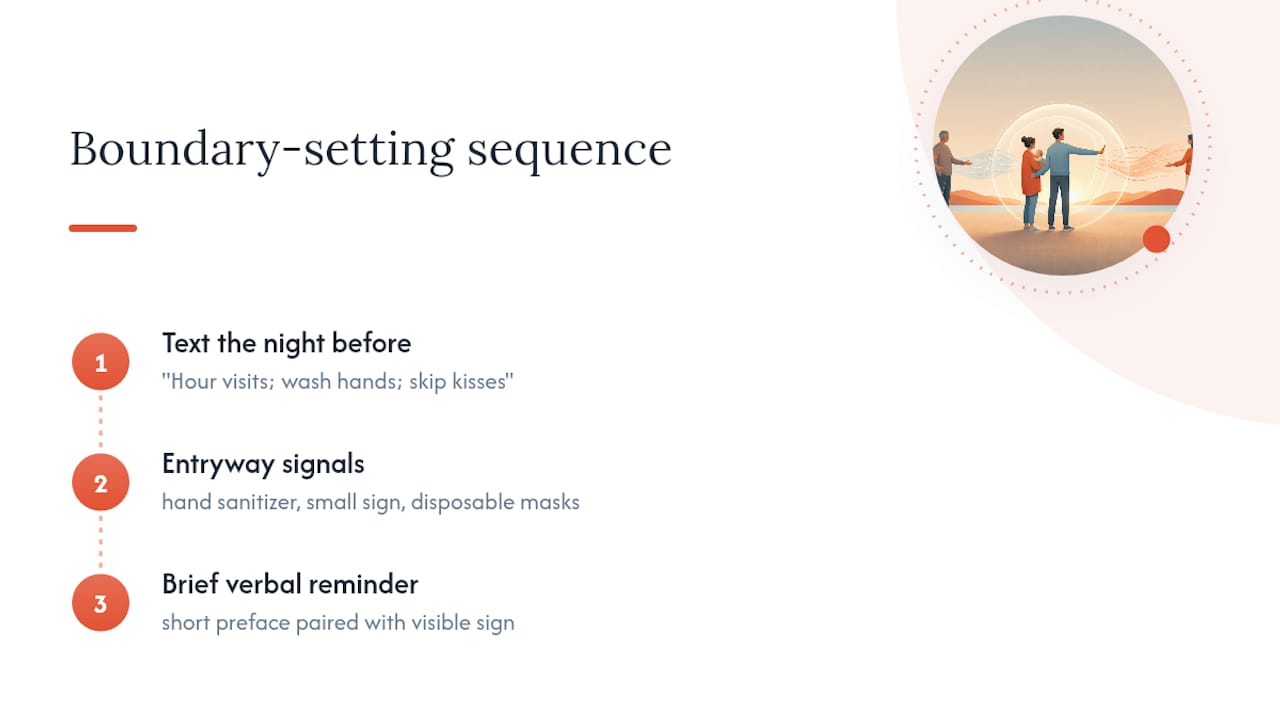
Nonverbal tools carry the same message without a single conversation. A hand sanitizer bottle by the door, a small handwritten sign, or a basket of disposable masks by the entryway all signal the house rule before anyone has to say it out loud.
This is where apparel earns its place. A bodysuit with a printed message does the reminding so parents don’t have to repeat themselves for the fifth time in a day. Babyineverylanguage’s own research into how families ask people not to kiss their newborn found that pairing a short verbal preface with a visible sign, rather than relying on the sign alone, works best with close family who might otherwise need a private and more uncomfortable conversation.
Different messages suit different rooms. A firm no-contact statement fits a crowded holiday gathering; something lighter works for a one-on-one visit with a well-meaning but forgetful uncle. That range is why multiple tones are designed rather than one universal phrase, and every wording is checked by a native speaker to ensure it lands naturally rather than sounding like an awkward translation, whether it’s in English or one of over twenty languages.
When Medical Reasons Should Delay Visitors Further
Some situations call for stricter rules than the standard week-one playbook. A baby who spent time in the NICU, was born premature, or is being monitored for feeding or weight-loss concerns needs a more cautious visitor policy, sometimes for weeks past the point a typical newborn would be cleared for casual guests.
- Recent NICU stay or prematurity: many clinicians recommend visitors follow hospital-level screening and masking at home for a period after discharge, not just the usual handwashing.
- Feeding or weight-gain concerns: fewer visitors means fewer distractions during a stretch when close feeding monitoring matters most.
- Any household member with active illness: this pushes the reschedule window out further than the standard one-week rule.
Pediatric checkups double as natural checkpoints for loosening restrictions. Newborns typically see a pediatrician within three to five days of birth, then again around one week for weight and feeding checks. A clean bill of health at that one-week visit is often the moment parents feel comfortable expanding the visitor list. Baystate Health notes some families wait two to three months before broader family visits, particularly during high viral activity seasons. There is no universal answer here, only what feels right for that specific baby’s health and that family’s local risk.
Why These Rules Come From Real Pediatric Guidance
Every rule in this piece traces back to actual clinical sources, not guesswork. Johns Hopkins Medicine and Sharp HealthCare both publish visitor guidance built around handwashing, vaccine timing, and illness-based rescheduling, and the CDC’s vaccine information statements explain the clinical reasoning behind Tdap and flu shot timing for caregivers.
Scripts and product phrasing were developed by testing wording with native speakers across more than twenty languages, checking that a boundary-setting phrase reads as friendly rather than harsh in each culture. That process, combined with the clinical sourcing above, is why the scripts on the publisher’s blog and the bodysuit phrasing hold up as more than a cute idea. They reflect actual pediatric consensus on what keeps a newborn safe.
How to Handle Unsolicited Advice From Visitors
Someone will tell you the baby is dressed too warmly, or not warmly enough, or that you’re holding the bottle wrong. It happens in nearly every family, and it usually comes from a good place even when it lands badly.
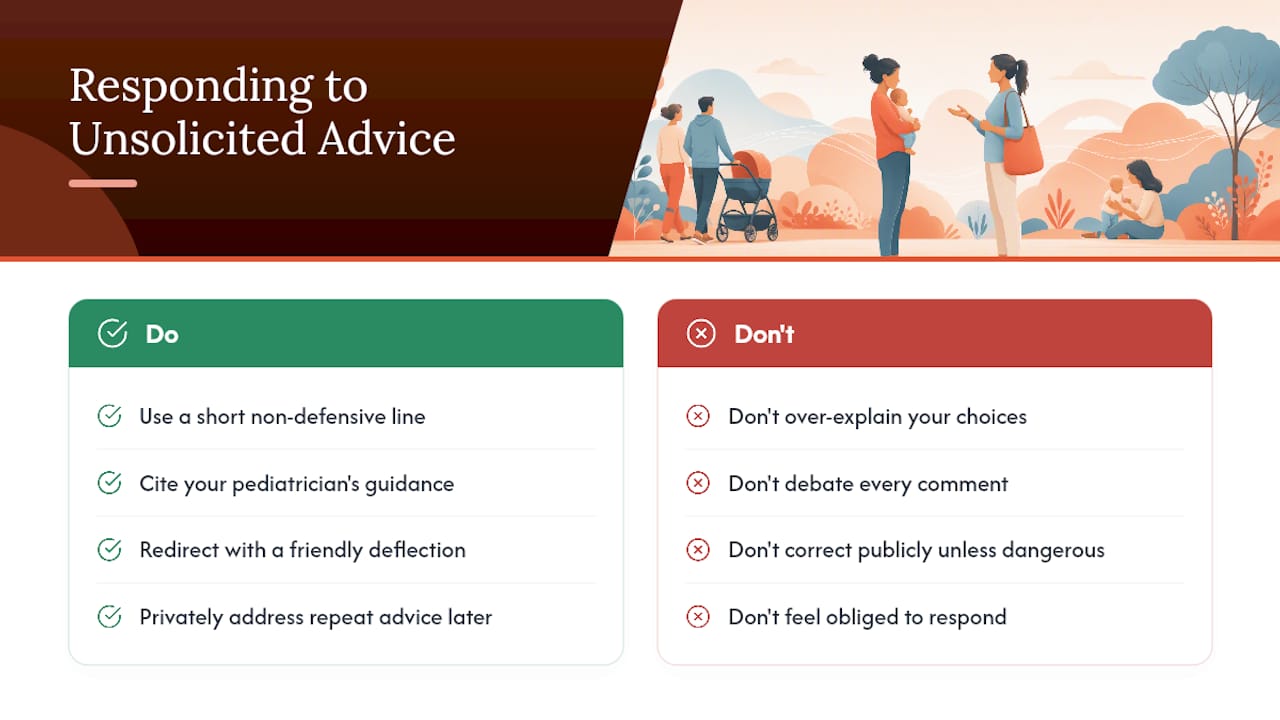
The most effective response is short and non-defensive: “Thanks, we’re following our pediatrician’s guidance on this one.” That single line closes the conversation without requiring a debate, and it works whether the topic is feeding schedules, sleep position, or how many blankets is too many.
Resist the urge to explain or justify every decision. New parents who over-explain end up in longer, more draining conversations than the ones who simply redirect. A firm, friendly deflection like “We’re figuring out what works for us” respects the visitor’s intent without opening the floor to further critique.
If the advice keeps coming from the same person, a private conversation later, once everyone is calmer, tends to work better than a correction in the moment. Save direct pushback for real safety issues (unwashed hands reaching for the baby, someone insisting on a kiss after being told no) where the moment calls for something firmer than a polite deflection. Everything else can wait, or simply be let go entirely. Not every comment needs a response, and choosing not to engage is its own valid form of boundary-setting.
Balancing Courtesy and Safety in Early Visits
Saying no to an excited grandparent or a well-meaning friend feels harder than it should, and that social pressure is real even when the rule itself is simple. The parent’s comfort comes first here, full stop. Guests get one takeaway worth remembering: ask before you show up, and follow the rules without making the parents repeat themselves. A little empathy on both sides, plus a script ready to go, turns a potentially awkward moment into a non-event.
— Bassem
How a No-Kiss Bodysuit Makes Boundaries Easier to Enforce
A printed bodysuit does the work of a hundred repeated reminders, especially during the extended-family gathering or the photo session where three well-meaning aunts all lean in at once. It is a low-conflict tool: nobody has to say anything, because the baby is already saying it.
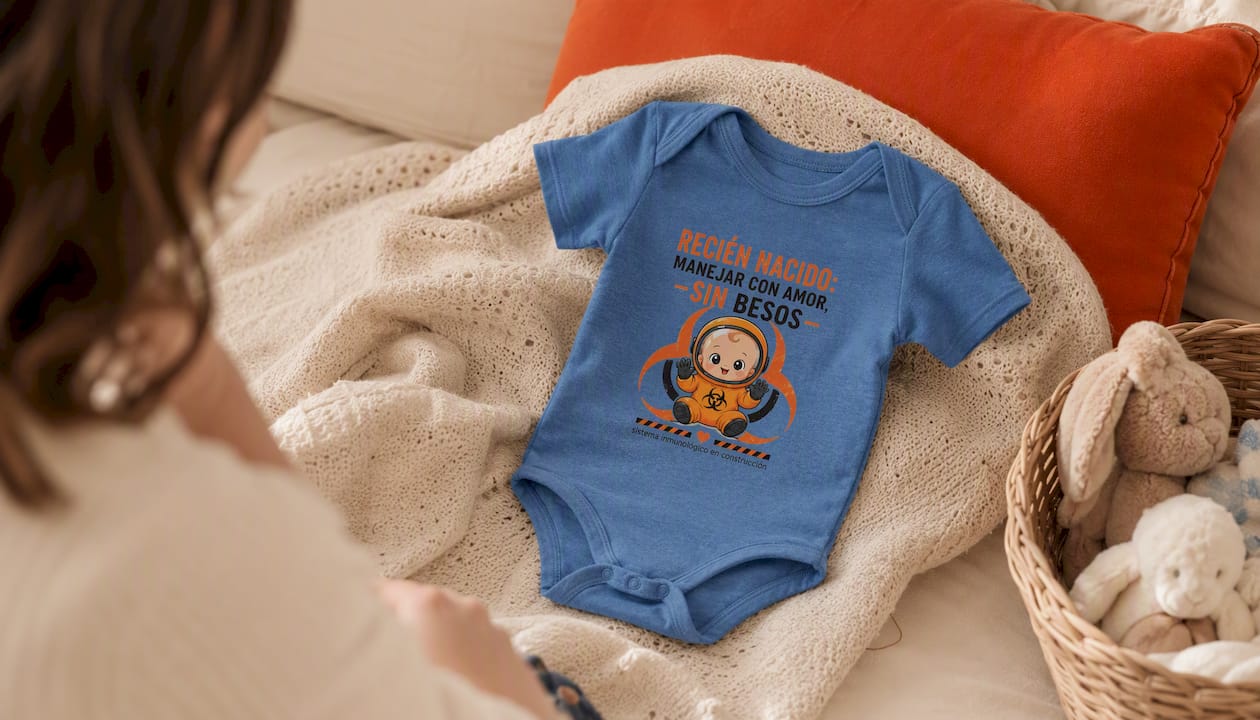
Different situations call for different tones. The Lips Keep Out Baby Bodysuit and No Kiss Zone Baby Bodysuit work well for casual, mixed-crowd events where a lighthearted message does the job. For firmer situations, like a persistent relative who needs a clearer signal, the Authorized Kisses None Baby Bodysuit or Keep Calm And Dont Kiss Me Baby Bodysuit state the rule outright. The Warning New And Fragile Baby Bodysuit leans on the “handle gently” framing, useful for visitors who need a general reminder about caution rather than a specific no-kiss rule, while the Newborn Handle With Love No Kissing Baby Bodysuit, No Smooching Allowed Baby Bodysuit, and Kiss Free Zone Baby Bodysuit round out the range for whatever tone fits your family.
Every bodysuit is printed on soft, baby-safe cotton with non-toxic inks, and every phrase is checked by a native speaker so it reads naturally in the language you choose, not just in English. Browse the full collection of boundary-setting onesies and pick the one that matches the visit you’re planning next.
Sources
- New Parents and Newborns: Are Visitors OK? | Johns Hopkins Medicine
- What To Do (And Not To Do) When Meeting A Newborn Baby | Henry Ford Health
- Visiting a Newborn: What Parents and Guests Should Know | Baystate Health
FAQ
What Are the Rules for Guests Visiting a Newborn?
Wash hands on arrival, skip kissing the baby, stay home if sick or recently exposed to illness, and confirm vaccine status for Tdap, flu, and COVID-19 before visiting.
What Is the 3-3-3 Rule for Newborns?
The 3-3-3 rule is a general newborn-adjustment guideline (roughly three weeks, three months, and beyond for developmental milestones) rather than a formal visitor policy, so it does not directly govern who should visit in week one.
How Soon Should Grandparents Visit a New Baby?
Many families welcome grandparents within the first few days, especially when they’re providing hands-on help, though timing ultimately depends on the parents’ recovery, the baby’s health, and local illness activity.
What Is the 5-5-5 Rule for Newborns?
The 5-5-5 rule generally refers to a postpartum recovery guideline (five days in bed, five days on the bed, five days near the bed) rather than a visitor rule, though it reinforces why keeping visits short in week one matters for parental rest.
How Long Should a First Visit With a Newborn Last?
Keep first-week visits between 30 and 60 minutes, timed to avoid feeding and nap windows, with shorter visits generally easier on both baby and parents.